Student Stress Level Prediction Using Machine Learning
A machine learning research project that predicts student stress levels based on psychological, physical, environmental, and social factors. Achieved 88.6% accuracy using a tuned Random Forest classifier.
Presented at PEARC25 as part of the NSF Leadership-Class Computing Facility (LCCF) Advanced Computing Student Challenge. Computation accelerated using TACC Stampede3 supercomputer.
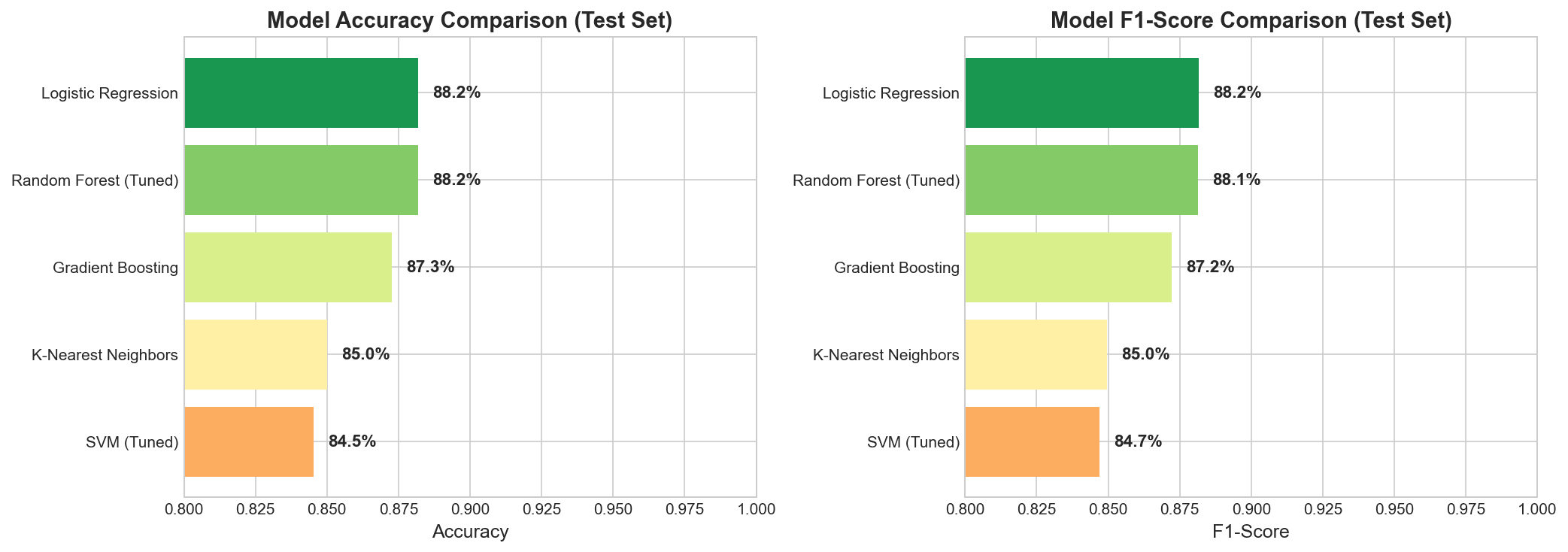
Model Performance
| Model | Test Accuracy | F1-Score |
|---|---|---|
| Random Forest (Tuned)Best | 88.6% | 88.6% |
| Logistic Regression | 88.2% | 88.2% |
| SVM (Tuned) | 87.7% | 87.7% |
| Gradient Boosting | 87.3% | 87.2% |
| K-Nearest Neighbors | 85.0% | 85.0% |
Top Stress Predictors
Dataset Features
Psychological
anxiety_level, self_esteem, mental_health_history, depression
Physical Health
headache, blood_pressure, sleep_quality, breathing_problem
Environmental
noise_level, living_conditions, safety, basic_needs
Academic
academic_performance, study_load, teacher_student_relationship
Social
future_career_concerns, social_support, peer_pressure, bullying
Key Insights
Social factors (bullying, peer pressure) have the highest impact on stress
Mental health indicators correlate strongly with stress levels
Physical symptoms (headache, sleep quality) serve as early warning signs
Random Forest with hyperparameter tuning achieved the best performance
Impact & Continuation
This research directly informed the design of my later systems, including the Class-Life Balance Optimizer and Study Companion. Rather than stopping at prediction, I used these insights to build tools that actively help students plan, recover, and adapt.